Elisa Maria de Oliveira Borga
Law student at FAE.
This article analyzes the reciprocal recognition of adequacy in data protection between Brazil and the European Union, formalized in 2026, which created the largest integrated area of international data flow in terms of territorial extent. This advancement was made possible by the convergence between the LGPD (Brazilian General Data Protection Law) and the GDPR (General Data Protection Regulation), which share principles, oversight mechanisms, and the recognition of data protection as a fundamental right. The study then examines the legal foundations of Resolution CD/ANPD No. 32/2026, as well as its limitations and the mechanism for periodic review. It also highlights the practical impacts of the measure, such as the simplification of international data transfers, the reduction of compliance costs, the strengthening of legal certainty, and the encouragement of investment and digital commerce. Finally, it addresses the geopolitical relevance of the decision, which reinforces Brazil's international insertion and its leading role in debates on digital governance and regulatory cooperation.
Keywords: Data Protection; International Data Transfer; European Union; Adequacy.
The article examines the reciprocal data protection adequacy recognition between Brazil and the European Union, formalized in 2026, establishing the world's largest integrated area for international data flows in terms of territorial scope. This outcome was enabled by the convergence between Brazil's LGPD and the EU GDPR, which share key principles, enforcement mechanisms, and the recognition of data protection as a fundamental right. The paper further analyzes the legal foundations of ANPD Resolution No. 32/2026, as well as its scope, limitations, and periodic review mechanism. It also highlights the practical impacts of the measure, including simplified international data transfers, reduced compliance costs, enhanced legal certainty, and increased incentives for investment and digital trade. Finally, it discusses the geopolitical significance of the decision, which strengthens Brazil's international position and its role in debates on digital governance and regulatory cooperation.
Keywords : Data Protection; International Data Transfers; European Union; Adequacy Recognition.
A historic milestone occurred in January 2026 in the area of privacy and data protection in Brazil. This refers to the reciprocal recognition of equivalence in data protection matters between Brazil and the European Union.
In practice, this recognition provides greater legal certainty for the international flow of data. Furthermore, international data transfer processes are simplified. Operational expenses tend to decrease. The implementation of business ventures, innovative projects, and international partnerships occurs more quickly.
The effects are especially relevant for sectors heavily dependent on data processing. These include technology, digital services, fintech, healthtech, digital platforms, and the data-driven economy.
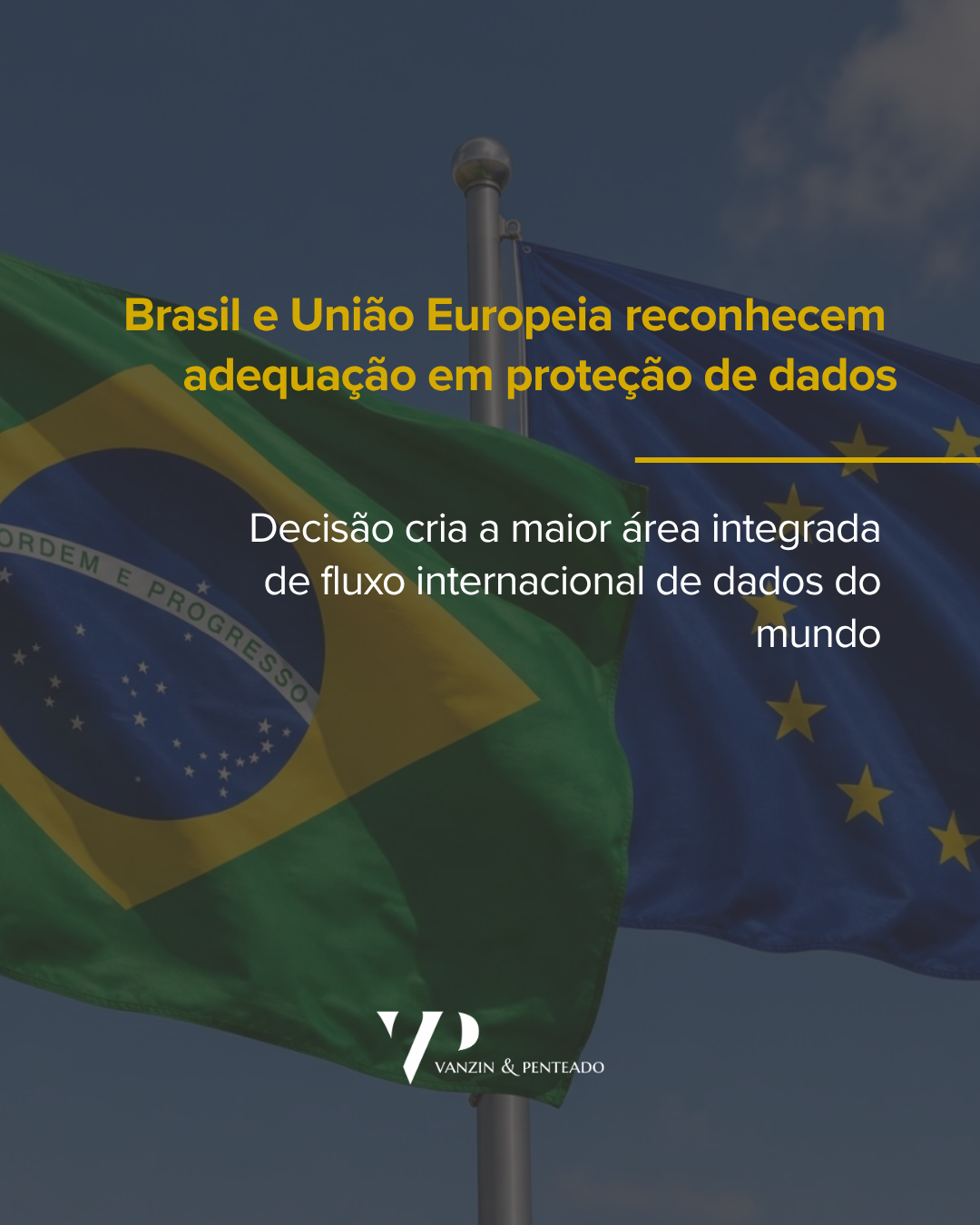
The measure's scope covers approximately 670 million individuals. In this way, trust is strengthened between the legal systems and the societies involved. Thus, an integrated space for data circulation, unprecedented in geographic extent, has been consolidated. This is the largest integrated data flow area in the world in territorial terms.
In this context, it is clear that one factor played a significant role in this mutual recognition. This is the influence of the General Data Protection Law (LGPD), Law No. 13.709/2018, which was inspired by the General Data Protection Regulation (GDPR) of the European Union, in force since 2018. This inspiration contributed to the construction of a Brazilian regulatory model aligned with the highest international standards for data protection. Furthermore, it facilitated regulatory dialogue between the two jurisdictions.
Both the LGPD (Brazilian General Data Protection Law) and the GDPR (General Data Protection Regulation) share fundamental principles of data protection. These include security, transparency, accountability, and guaranteeing the rights of data subjects. Furthermore, both regimes promote the ethical and legitimate processing of personal information.
Both laws have extraterritorial scope. They also provide for administrative sanctions in case of non-compliance and establish monitoring mechanisms.
In Brazil, this function is performed by the National Data Protection Authority (ANPD). On the other hand, in the European Union, supervision is carried out by the national data protection authorities of the member states. These authorities are coordinated by the European Data Protection Board (EDPB).
Furthermore, there are equivalent figures in data processing. These include the controller, the operator (processor, in the GDPR), and the Data Protection Officer (DPO). However, there are specific differences in their responsibilities.
The convergence between Brazilian and European legal systems is not limited to the sub-constitutional level. In both systems, the protection of personal data is recognized as a fundamental right.
In the European Union, this recognition stems from Article 8 of the Charter of Fundamental Rights of the European Union and Article 16 of the Treaty on the Functioning of the European Union. In Brazil, data protection was elevated to a fundamental right by Constitutional Amendment No. 115/2022, which included item LXXIX in Article 5 of the Federal Constitution.
This regulatory convergence reinforces the compatibility between data protection regimes. Furthermore, it contributes to the assessment of equivalence between the two jurisdictions.
Finally, it is worth noting that the ANPD (Brazilian National Data Protection Authority) assessed the normative equivalence of the European Union based on Article 34 of the LGPD (Brazilian General Data Protection Law). This analysis considered criteria such as the nature of the data, observance of principles, judicial guarantees, and the overall level of protection.
In the European Union, this recognition stems from Article 8 of the Charter of Fundamental Rights of the European Union. It is also based on Article 16 of the Treaty on the Functioning of the European Union.
In Brazil, data protection was elevated to a fundamental right by Constitutional Amendment No. 115/2022. The amendment included item LXXIX in article 5 of the Federal Constitution.
It should be noted that the scope of applicability of the measure is already defined in the sole paragraph of Article 1 of the resolution, which applies to:
for all Member States of the European Union, the three countries of the European Free Trade Association - EFTA that are part of the European Economic Area - EEA (Iceland, Liechtenstein and Norway), as well as the institutions, bodies and agencies of the European Union.
Furthermore, the decision emphasized that the measure does not apply to international data transfers carried out exclusively for purposes of public security, national defense, state security, or activities related to the investigation and repression of criminal offenses (Article 2).
Resolution No. 32 of the ANPD (National Data Protection Authority) also provides that the agency will continuously monitor the level of personal data protection maintained by the European Union. Furthermore, it may request additional information and conduct periodic assessments (Article 4).
It is emphasized that the decision is not permanent. It will be reassessed within four years (Article 4, §1), that is, in 2030. This reassessment will consider, among other aspects, any changes in personal data protection legislation subsequent to the adaptation decision (Article 4, §2).
Regarding the practical and economic impacts of the decision, greater legal certainty is expected. Furthermore, cost reductions, improved competitiveness, and encouragement of reciprocal investments are anticipated.
The practical consequences include the simplification of data transfers between Brazil and the European Union. A reduction in compliance costs is also a key factor. In this context, the need for customized transfer mechanisms and additional audits focused exclusively on enabling the international flow of data is reduced.
Furthermore, this measure is expected to strengthen institutional cooperation between the ANPD (Brazilian National Data Protection Authority), the European Commission, and European data protection authorities. This cooperation occurs through the exchange of information, the sharing of best practices, regulatory convergence, and the continuous monitoring of protection levels.
The adaptation should also facilitate digital commerce, which depends on the cross-border flow of data. This is expected to make the provision of digital services easier. It is also projected to reduce transaction costs and stimulate data-driven businesses. Furthermore, it will strengthen the presence of Brazilian companies in the European market.
Finally, the measure could increase Brazil's attractiveness for foreign investment, especially in the technology, fintech, healthtech, artificial intelligence, analytics, and data processing sectors.
In addition to Brazil, the European Union has 16 adequacy decisions in force that allow the free flow of personal data within the European Union. The countries and territories covered are: Andorra, Argentina, Canada (applicable to commercial organizations), South Korea (Republic of Korea), United States (for commercial organizations certified under the EU-US Data Privacy Framework), Guernsey, Isle of Man, Faroe Islands, Israel, Japan, Jersey, New Zealand, United Kingdom, Switzerland, and Uruguay.
From a geopolitical standpoint, Brazil positions itself as a strategic partner of the European Union. This partnership is reaffirmed with the formalization of the "Brazil-European Union Digital Partnership," which took place on June 12, 2026. This establishes Brazil as a priority digital partner of the European Union and, furthermore, as the first in Latin America to join the network of advanced technological cooperation. This network of priority partners includes South Korea, Japan, Singapore, and Canada.
It is important to highlight that the agreement between Brazil and the European Union does not alter the flow of data between Brazil and the United States of America. This is because adequacy decisions are specific to each jurisdiction. Thus, the recognition of adequacy between the European Union and the ANPD (Brazilian National Data Protection Authority) does not automatically affect data transfers to the United States. This is because such transfers remain subject to the specific mechanisms provided for by the LGPD (Brazilian General Data Protection Law).
The mutual recognition of adequacy between Brazil and the European Union represents one of the most significant milestones in the recent history of personal data protection in the country. This measure goes beyond simplifying international data transfers; it also symbolizes the maturity of the Brazilian data protection system. This system was built upon the LGPD (Brazilian General Data Protection Law), the strengthening of the ANPD (National Data Protection Authority), and the constitutional enshrinement of data protection as a fundamental right.
In short, the Brazil-EU decision produces effects that go beyond simplifying international data transfers. Recognition of adequacy reduces compliance costs and increases legal certainty for economic agents, strengthens international regulatory cooperation, and promotes Brazil's integration into the global digital economy. From an economic perspective, the measure tends to stimulate investment and facilitate cross-border data flows.
Furthermore, this compliance reinforces Brazil's position on the international stage. The country also moves closer to jurisdictions recognized by the European Union as having high standards of data protection. Together with the Brazil-European Union Digital Partnership, the decision highlights Brazil's leading role in debates on digital governance and cross-border data flows.
However, maintaining this status depends on continuous monitoring and preserving the levels of protection that underpinned the decision. Periodic reassessment by the ANPD demonstrates that compliance is not a definitive achievement. It is a permanent commitment to regulatory evolution and the effectiveness of data subjects' rights.
Finally, mutual recognition should be understood not only as an end point, but as the beginning of a new stage of regulatory integration. Furthermore, it indicates the strengthening of institutional cooperation and the digital economy between Brazil and the European Union.
References
https://ec.europa.eu/commission/presscorner/detail/en/ip_26_229
https://ec.europa.eu/commission/presscorner/detail/pl/ip_24_161
Published by:
© 2024 Vanzin & Penteado Advogados Associados.